
MangaWire is a news outlet devoted to manga, launched in 2026 by Antoine Brault. It is edited in France and published in French, Spanish and English on the same day, from the same sources.
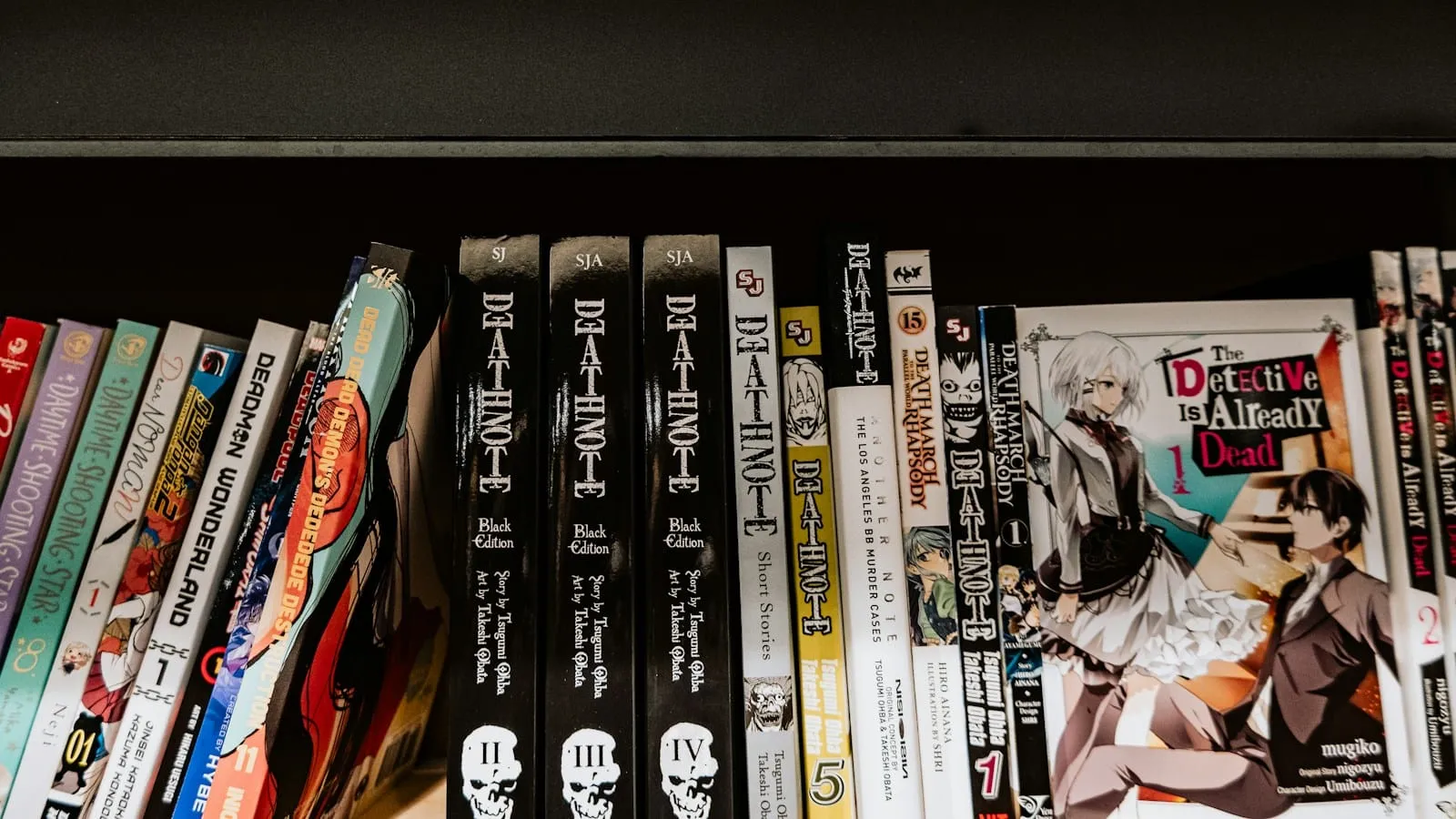
Photo: Samuel Regan-Asante / Unsplash.
Where MangaWire came from
From one specific irritation: looking up a release date and finding three different answers.
Manga has become a substantial industry outside Japan, and the information around it has stayed cottage-scale. Release calendars circulate copied from site to site without anyone going back to the publisher’s catalogue. A rumour posted on a forum becomes an announcement within two days. A sales figure quoted without a source travels the web until nobody knows where it started.
Readers want to know three things: whether it is true, when it ships, and what it costs. Those are the simplest questions, and they are the ones for which a reliable answer is hardest to find.
MangaWire was built on that observation. Not to publish more, or faster, but to publish what can be checked. We wrote our method before our first article, and we made the site technically refuse to publish a text that breaks it.
What we cover
Four areas, each with its own way of working.
| Section | What you will find | What matters |
|---|---|---|
| News | Publisher and magazine announcements, adaptations, series endings | Going back to the primary source before publishing |
| Releases | Release calendars, publisher by publisher, month by month | Checking every date against at least two catalogues |
| Industry | Publishing houses, platforms, market figures | Citing the origin of every figure, every time |
| Guides | Where to start, what order to read in, which edition to buy | A reasoned recommendation, not a ranking |
We do not publish mood-piece reviews or fan theories. When we give an opinion, it is signed and presented as one.
Photo: Beth Stevenson / Unsplash.
Our method, and how to check it
Expertise is not declared, it is demonstrated. Here is what we hold ourselves to, and where you can verify it.
Every article cites its sources. Not in a vague note, but as a list of links at the foot of the article. This is not a habit we try to keep: it is a technical constraint. The site refuses to build a published article without at least one declared source. There is therefore no article without a source on MangaWire, and there cannot be one.
Our mistakes stay visible. When we get something wrong, we correct it and leave the trace: a dated note at the foot of the article stating what was wrong and what changed. We do not quietly rewrite. In September 2026, our Glénat calendar credited that publisher with series released by other houses. We rebuilt it entirely, in all three languages, and the correction note is still at the bottom of the article.
We separate three levels of reliability. Information confirmed by a primary source, information reported by an identified outlet, and rumour. The three are not written the same way, and a rumour always carries a box saying so.
We do not relay scans or leaked chapters. Neither their contents nor plot details drawn from them, without exception. When information travels that way, we wait for the official announcement. It costs us hours of visibility, sometimes days. It is a choice, and it is not negotiable.
Our translations are not copies. Every article exists in three versions published the same day, with the same sources and the same figures, but written for their readership: a French calendar does not concern an English-speaking reader in the same way, and the English version says so from the opening line.
The editorial policy sets out these rules, and the corrections policy describes what happens when an error is reported to us.
Why three languages
Manga sells in three large markets outside Japan: France, Spain and Spanish-speaking America, and the English-speaking world. An announcement made in Tokyo concerns all three at once, but the information travels at very different speeds depending on the language. A Japanese press release sometimes takes a week to cross into Spanish, while English coverage appears within the hour.
MangaWire publishes every article on the same day in all three languages. The language switcher at the top of the page always leads to the translation of the article you are reading, never to the home page.

Photo: Connor Gan / Unsplash.
The newsroom
MangaWire is run by Antoine Brault, founder and editor in chief. A manga reader since middle school, he follows Japanese, French and Spanish-language publishing news daily, and writes most of the articles published to date.
The newsroom is young, and we would rather say so than let you work it out. What we put forward is not the number of people writing, but the way each article is checked before it goes out. An outlet with ten writers copying calendars without verifying them is worth less than one article whose every date was confirmed against two catalogues.
All articles are signed. The authors page introduces each byline, their role and their articles.
We are looking for specialist contributors: Japanese publishing and the domestic market, the Spanish-language market, animation, merchandise and events. If you know one of those areas and the method above suits you, write to us through the contact page with two or three writing samples.
Our commitments
| What we promise | How to check it |
|---|---|
| All information is sourced | The source list appears at the foot of every article |
| Errors are corrected and flagged | Dated note at the foot of the article concerned |
| Rumours are announced as rumours | “Rumour” box and a conditional headline |
| No content drawn from scans | No plot details before official publication |
| Paid content is disclosed | Label at the top and a sponsored attribute on links |
| All three languages say the same thing | Same sources, same figures, same date |
Independence and funding
MangaWire is self-funded, supplemented by advertising and commercial partnerships. Those are always disclosed: a sponsored article carries the label at the top, and a paid link carries the sponsored attribute.
A partnership does not buy editorial content. It buys neither a favourable review, nor silence on a subject, nor a place in our guides. The terms are public and set out on the contact page.
Write to us
Information to check, a press release, an error you spotted, a commercial proposal: the contact page explains how to reach us and how quickly we reply.